How Do You Read a Candle That's Not in Glass

A candle in a candle stick

A candle is an ignitable wick embedded in wax, or another flammable solid substance such as tallow, that provides calorie-free, and in some cases, a fragrance. A candle tin too provide heat or a method of keeping fourth dimension.
A person who makes candles is traditionally known as a chandler.[one] Various devices have been invented to hold candles, from simple tabletop candlesticks, also known as candle holders, to elaborate candelabrum and chandeliers.[2]
For a candle to burn, a rut source (commonly a naked flame from a match or lighter) is used to light the candle's wick, which melts and vaporizes a small amount of fuel (the wax). Once vaporized, the fuel combines with oxygen in the temper to ignite and form a constant flame. This flame provides sufficient rut to keep the candle burning via a self-sustaining concatenation of events: the rut of the flame melts the top of the mass of solid fuel; the liquefied fuel so moves upwardly through the wick via capillary action; the liquefied fuel finally vaporizes to burn within the candle'south flame.
As the fuel (wax) is melted and burned, the candle becomes shorter. Portions of the wick that are not emitting vaporized fuel are consumed in the flame. The incineration of the wick limits the length of the exposed portion of the wick, thus maintaining a constant burning temperature and rate of fuel consumption. Some wicks crave regular trimming with scissors (or a specialized wick trimmer), usually to about one-quarter inch (~0.vii cm), to promote slower, steady called-for, and also to foreclose smoking. Special candle pair of scissors called "snuffers" were produced for this purpose in the 20th century and were often combined with an extinguisher. In modern candles, the wick is synthetic so that it curves over as it burns. This ensures that the end of the wick gets oxygen and is so consumed by fire—a cocky-trimming wick.[3]
Etymology
The give-and-take candle comes from Middle English candel , from Old English and from Anglo-Norman candele , both from Latin candēla , from candēre 'to shine'.[iv]
History
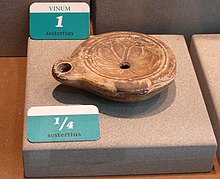
Prior to the candle, people used oil lamps in which a lit wick rested in a container of liquid oil. Romans began making true dipped candles from tallow, beginning around 500 BC.[v] European candles of antiquity were made from various forms of natural fatty, tallow, and wax. In Aboriginal Rome, candles were made of tallow due to the prohibitive cost of beeswax.[6] They may have also existed in Aboriginal Greece, but imprecise terminology makes it difficult to determine.[6] The earliest surviving candles originated in Han China effectually 200 BC. These early Chinese candles were made from whale fat.
During the Middle Ages, tallow candles were most ordinarily used. By the 13th century, candle making had become a guild craft in England and French republic. The candle makers (chandlers) went from business firm to house making candles from the kitchen fats saved for that purpose, or made and sold their own candles from small candle shops.[7] Beeswax, compared to animal-based tallow, burned cleanly, without smoky flame. Beeswax candles were expensive, and relatively few people could afford to burn down them in their homes in medieval Europe. However, they were widely used for church building ceremonies.[8]
In the 18th and 19th centuries, spermaceti, a waxy substance produced by the sperm whale, was used to produce a superior candle that burned longer, brighter and gave off no offensive aroma.[9] Afterwards in the 18th century, colza oil and rapeseed oil came into use as much cheaper substitutes.
Modern era

Price'south Candles had become the largest candle manufacturer in the earth by the end of the 19th century
The manufacture of candles became an industrialized mass market in the mid 19th century. In 1834, Joseph Morgan,[10] a pewterer from Manchester, England, patented a car that revolutionised candle making. It allowed for continuous production of molded candles past using a cylinder with a moveable piston to eject candles equally they solidified. This more efficient mechanized production produced virtually i,500 candles per hour. This allowed candles to be an affordable commodity for the masses.[xi] Candlemakers also began to way wicks out of tightly braided (rather than but twisted) strands of cotton fiber. This technique makes wicks scroll over equally they burn, maintaining the superlative of the wick and therefore the flame. Because much of the excess wick is incinerated, these are referred to as "self-trimming" or "self-consuming" wicks.[12]
In the mid-1850s, James Young succeeded in distilling paraffin wax from coal and oil shales at Bathgate in West Lothian and developed a commercially viable method of production.[xiii] Alkane series could exist used to brand inexpensive candles of high quality. It was a bluish-white wax, which burned cleanly and left no unpleasant odour, dissimilar tallow candles. By the stop of the 19th century, candles were fabricated from paraffin wax and stearic acid.
By the tardily 19th century, Price'south Candles, based in London, was the largest candle manufacturer in the globe.[14] Founded by William Wilson in 1830,[15] the visitor pioneered the implementation of the technique of steam distillation, and was thus able to manufacture candles from a broad range of raw materials, including skin fatty, bone fat, fish oil and industrial greases.
Despite advances in candle making, the candle manufacture declined chop-chop upon the introduction of superior methods of lighting, including kerosene and lamps and the 1879 invention of the incandescent light bulb. From this point on, candles came to be marketed every bit more than of a decorative particular.[sixteen]
Use

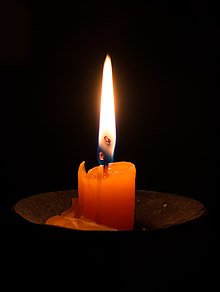
Closeup view of candle at night
Before the invention of electric lighting, candles and oil lamps were commonly used for illumination. In areas without electricity, they are withal used routinely. Until the 20th century, candles were more mutual in northern Europe. In southern Europe and the Mediterranean, oil lamps predominated.
In the developed world today, candles are used mainly for their aesthetic value and aroma, specially to set a soft, warm, or romantic ambiance, for emergency lighting during electrical power failures, and for religious or ritual purposes.[17]
In the 21st century, there has been a huge spike in sales of scented candles in recent years.[eighteen] [17] The Covid-xix pandemic and the ensuring lockdowns led to a dramatic increase in the sales of scented candles, diffusers and room sprays. [nineteen]
Other uses
With the fairly consequent and measurable burning of a candle, a mutual use of candles was to tell the fourth dimension. The candle designed for this purpose might have time measurements, usually in hours, marked along the wax. The Song dynasty in China (960–1279) used candle clocks.[xx]
By the 18th century, candle clocks were being made with weights set up into the sides of the candle. As the candle melted, the weights fell off and made a noise as they vicious into a basin.
In the days leading to Christmas, some people burn a candle a set up amount to represent each twenty-four hour period, as marked on the candle. The blazon of candle used in this way is called the Advent candle,[21] although this term is also used to refer to a candle that are used in an Advent wreath.
Components
Wax

The hydrocarbon C31H64 is a typical component of paraffin wax, from which most modern candles are produced.


For well-nigh of recorded history candles were made from tallow (rendered from beef or mutton-fat) or beeswax. From the mid 1800s they were also made from spermaceti, a waxy substance derived from the Sperm whale, which in turn spurred demand for the substance. Candles were also made from stearin (initially manufactured from animal fats but now produced almost exclusively from palm waxes).[22] [23] Today, most candles are made from paraffin wax, a byproduct of petroleum refining.[24]
Candles can also be made from microcrystalline wax, beeswax (a byproduct of dear collection), gel (a mixture of polymer and mineral oil),[25] or some constitute waxes (more often than not palm, carnauba, bayberry, or soybean wax).
The size of the flame and corresponding rate of burning is controlled largely past the candle wick. The kind of wax also affects the burn charge per unit, with beeswax and kokosnoot wax burning longer than paraffin or soy wax.[26]
Production methods utilize extrusion moulding.[24] More traditional production methods entail melting the solid fuel by the controlled awarding of oestrus. The liquid is and so poured into a mould, or a wick is repeatedly immersed in the liquid to create a dipped tapered candle. Oftentimes fragrance oils, essential oils or aniline-based dye is added.
Wick
A candle wick works by capillary action, cartoon ("wicking") the melted wax or fuel upwardly to the flame. When the liquid fuel reaches the flame, information technology vaporizes and combusts. The candle wick influences how the candle burns. Important characteristics of the wick include bore, stiffness, fire resistance, and tethering.
A candle wick is a piece of string or cord that holds the flame of a candle. Commercial wicks are made from braided cotton. The wick'due south capillarity determines the charge per unit at which the melted hydrocarbon is conveyed to the flame. If the capillarity is also great, the molten wax streams down the side of the candle. Wicks are often infused with a diversity of chemicals to alter their called-for characteristics. For example, it is normally desirable that the wick not glow after the flame is extinguished. Typical agents are ammonium nitrate and ammonium sulfate.[24]
Characteristics
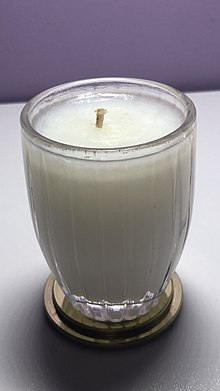
A pocket-size ornamental candle with a gilt stand
Light

A room lit by the glow of many candles
Based on measurements of a taper-blazon, paraffin wax candle, a modernistic candle typically burns at a steady rate of about 0.1 thousand/min, releasing rut at roughly 80 W.[27] The light produced is about xiii lumens, for a luminous efficacy of nigh 0.16 lumens per watt (luminous efficacy of a source) – almost a hundred times lower than an incandescent light bulb.
The luminous intensity of a typical candle is approximately one candela. The SI unit, candela, was in fact based on an older unit called the candlepower, which represented the luminous intensity emitted by a candle made to item specifications (a "standard candle"). The modern unit is defined in a more precise and repeatable fashion, but was called such that a candle's luminous intensity is still about one candela.
Temperature
The hottest function of a candle flame is just higher up the very dull blue role to one side of the flame, at the base of operations. At this betoken, the flame is nigh one,400 °C (ii,550 °F). All the same notation that this role of the flame is very modest and releases little heat free energy. The blueish color is due to chemiluminescence, while the visible xanthous color is due to radiative emission from hot soot particles. The soot is formed through a series of complex chemical reactions, leading from the fuel molecule through molecular growth, until multi-carbon ring compounds are formed. The thermal construction of a flame is circuitous, hundreds of degrees over very short distances leading to extremely steep temperature gradients. On average, the flame temperature is about 1,000 °C (1,830 °F).[28] The colour temperature is approximately 1000 G.
Candle flame
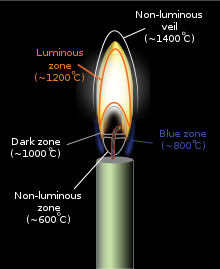
Five zones of a standard domestic candle flame
A candle flame is formed because wax vaporizes on burning. A candle flame is widely recognized as having between three and 5 regions or "zones":
- Zone I - this is the non-luminous, lowest, and coolest part of the candle flame. It is located around the base of operations of the wick where there is bereft oxygen for fuel to burn. Temperatures are effectually 600 °C (ane,112 °F).
- Zone II - this is the blue zone which surrounds the base of the flame. Here the supply of oxygen is plentiful, and the fuel burns clean and blue. It is estrus from this zone which causes the wax to melt. Temperatures are around 800 °C (1,470 °F)
- Zone III - the dark zone is a region directly above the wick containing unburnt wax. Pyrolysis takes place here. Temperature is effectually 1,000 °C (1,830 °F)
- Zone IV - the middle or luminous zone is yellow/ white and is located above the dark zone. Information technology is the brightest zone, but non the hottest. Information technology is an oxygen-depleted zone with insufficient oxygen to burn down all of the wax vapor rising from below it resulting in just partial combustion. The zone besides contains unburnt carbon particles. Temperature is around one,200 °C (2,190 °F).
- Zone 5 - The non-luminous outer zone or veil surrounds Zone Iv. Hither the flame is at its hottest, at effectually one,400 °C (2,550 °F), and complete combustion occurs. Information technology is light blue in color though well-nigh of information technology is invisible.[29] [30]
The principal determinant of the height of a candle flame is the diameter of the wick. This is evidenced in tealights where the wick is very sparse and the flame is very minor. Candles whose main purpose is illumination utilise a much thicker wick.[31]
History of study
One of Michael Faraday's significant works was The Chemical History of a Candle, where he gives an in-depth analysis of the evolutionary development, workings and science of candles.[32]
Hazards
Co-ordinate to the National Fire Protection Association, candles are a leading source of residential fires in the U.s.a. with almost 10% of noncombatant injuries and vi% of fatalities from fire attributed to candles.[33]
A candle flame that is longer than its laminar smoke point will emit soot.[34] Proper wick trimming will reduce soot emissions from near candles.
The liquid wax is hot and can cause skin burns, but the amount and temperature are generally rather express and the burns are seldom serious. The best mode to avoid getting burned from splashed wax is to use a candle snuffer instead of blowing on the flame. A candle snuffer is usually a pocket-size metal cup on the end of a long handle. Placing the snuffer over the flame cuts off the oxygen supply. Snuffers were common in the dwelling house when candles were the main source of lighting before electric lights were bachelor. Ornate snuffers, often combined with a taper for lighting, are notwithstanding found in those churches which regularly utilise large candles.
Glass candle-holders are sometimes croaky past thermal shock from the candle flame, particularly when the candle burns down to the terminate. When burning candles in glass holders or jars, users should avoid lighting candles with chipped or croaky containers, and stop utilise once one/2 inch or less of wax remains.
A former worry regarding the rubber of candles was that a lead core was used in the wicks to keep them upright in container candles. Without a stiff core, the wicks of a container candle could sag and drown in the deep wax pool. Concerns rose that the pb in these wicks would vaporize during the burning process, releasing lead vapors — a known health and developmental risk. Lead core wicks have not been common since the 1970s. Today, most metal-cored wicks use zinc or a zinc alloy, which has get the industry standard. Wicks fabricated from peculiarly treated newspaper and cotton are also available.
Users who seek the aesthetics of a candle sometimes install an electric flameless candle to avert the hazards.
Regulation
International markets have developed a range of standards and regulations to ensure compliance, while maintaining and improving safety, including:
- Europe: GPSD, EN 15493, EN 15494, EN 15426, EN 14059, Accomplish, RAL-GZ 041 Candles (Germany), French Decree 91-1175
- United States: ASTM F2058, ASTM F2179, ASTM F2417, ASTM F2601, ASTM F2326 ( all are federal and applies in all 50 states), California Proposition 65 (California only), CONEG (New England and New York states simply)
- China: QB/T 2119 Basic Candle, QB/T 2902 Art Candle, QB/T 2903 Jar Candle, GB/T 22256 Jelly Candle
Accessories

Candle holders
Decorative candleholders, specially those shaped as a pedestal, are called candlesticks; if multiple candle tapers are held, the term candelabrum is likewise used. The root form of chandelier is from the word for candle, but now usually refers to an electric fixture. The give-and-take chandelier is sometimes now used to describe a hanging fixture designed to concord multiple tapers.
Many candle holders use a friction-tight socket to keep the candle upright. In this case, a candle that is slightly too wide will not fit in the holder, and a candle that is slightly also narrow will wobble. Candles that are besides big can exist trimmed to fit with a pocketknife; candles that are also small can exist fitted with aluminium foil. Traditionally, the candle and candle holders were made in the same identify, so they were appropriately sized, but international merchandise has combined the modern candle with existing holders, which makes the ill-plumbing equipment candle more common. This friction tight socket is simply needed for the federals and the tapers. For tea light candles, there is a diversity of candle holders, including small glass holders and elaborate multi-candle stands. The same is true for votives. Wall sconces are available for tea light and votive candles. For pillar-blazon candles, the assortment of candle holders is broad. A fireproof plate, such as a glass plate or pocket-size mirror, can exist a candle holder for a pillar-style candle. A pedestal of whatever kind, with the appropriate-sized fireproof top, is some other option. A large glass bowl with a large flat bottom and tall generally vertical curved sides is called a hurricane. The pillar-style candle is placed at the bottom middle of the hurricane. A hurricane on a pedestal is sometimes sold as a unit of measurement.
A bobèche is a drip-catching ring, which may also be affixed to a candle holder, or used independently of 1. Bobèches can range from ornate metal or glass to simple plastic, cardboard, or wax newspaper. Use of paper or plastic bobèches is mutual at events where candles are distributed to a crowd or audience, such every bit Christmas carolers or people at other concerts/festivals.
Candle followers
These are glass or metal tubes with an internal stricture partway along, which sit around the top of a lit candle. Every bit the candle burns, the wax melts and the follower holds the melted wax in, whilst the stricture rests on the topmost solid portion of wax. Candle followers are often deliberately heavy or weighted to ensure they move downwardly as the candle burns lower, maintaining a seal and preventing wax escape. The purpose of a candle follower is threefold:
- To contain the melted wax, making the candle more efficient, avoiding mess, and producing a more than even burn.
- Every bit a ornamentation, either due to the ornate nature of the device, or (in the case of a drinking glass follower) through lite dispersion or colouration.
- If necessary, to shield the flame from current of air.
Candle followers are often found in churches on altar candles.
Candle snuffers
Candle snuffers are instruments used to extinguish burning candles past smothering the flame with a small metal loving cup that is suspended from a long handle, and thus depriving it of oxygen. An older meaning refers to a scissor-like tool used to trim the wick of a candle. With skill, this could be done without extinguishing the flame. The instrument at present known as a candle snuffer was formerly chosen an "extinguisher" or "douter".
See also
- Candle-making
- Candle warmer
- Candelabra
- Julleuchter
- Outdoor candle
- Rushlight
- Singing candle
- Tealight
- Play tricks candles
- Trudon
- Unity candle
- Yahrzeit candle
References
- ^ "Chandler". The Free Dictionary Past Farlex. Retrieved 2012-05-19 .
- ^ "chandelier". The Free Dictionary By Farlex. Retrieved 2012-05-19 .
- ^ European Candle Association FAQ Archived 2012-01-13 at the Wayback Machine.
- ^ "Candle". The Complimentary Dictionary By Farlex. Retrieved 2012-05-19 .
- ^ "Candles, Roman, 500 BCE". Smith Higher Museum.
- ^ a b Forbes, R J (1955). Studies in Aboriginal applied science. pp. 139–40. ISBN978-9004006263 . Retrieved 7 November 2014.
- ^ "History of candles". National Candle Clan. Archived from the original on May 17, 2012. Retrieved 2012-05-19 .
- ^ "history of candle". national candle clan.
- ^ Shillito, One thousand. Larry; David J. De Marle (1992). Value: Its Measurement, Design, and Management. Wiley-IEEE. p. 33. ISBN978-0-471-52738-1.
- ^ "Joseph Morgan and Son". Graces Guide.
- ^ Phillips, Gordon (1999). Vii Centuries of Lite: The Tallow Chandlers Company. Volume Production Consultants. p. 74. ISBN978-1-85757-064-9.
- ^ "A Brief History of Candles". Archived from the original on 2013-03-eighteen. Retrieved 2015-07-06 .
- ^ Golan, Tal (2004). Laws of Men and Laws of Nature: The History of Scientific Good Testimony in England and America. Harvard University Press. pp. 89–91. ISBN978-0674012868.
- ^ Geoff Marshall (2013). London's Industrial Heritage. The History Press. ISBN9780752492391.
- ^ Brawl, Michael; David Sunderland (2001). An Economical History of London, 1800-1914. Routledge. pp. 131–132. ISBN978-0415246910.
- ^ Sekimoto, Hiroshi; Ryu, Kouichi; Yoshimura, Yoshikane (2001-11-01). "CANDLE: The New Burnup Strategy". Nuclear Scientific discipline and Engineering. 139 (iii): 306–317. doi:10.13182/NSE01-01. ISSN 0029-5639. S2CID 121714669.
- ^ a b Ferrier, Morwenna (19 December 2018). "The cult of 'smellness': what's backside the extraordinary rise in sales of scented candles?". The Guardian. Guardian News & Media Limited. Retrieved 4 Feb 2021.
- ^ Forest, Zoe (x Nov 2020). "UK sales of scented candles soar as Covid restrictions tighten". The Guardian. The Guardian News & Media Express. Retrieved four February 2021.
- ^ Thomas, Ellen (10 April 2020). "Candles Burn Bright Amongst Coronavirus Pandemic". WWD. Penske Media Corporation. Retrieved 24 May 2021.
- ^ Whitrow, One thousand. J. (1989). Time in History: Views of Time from Prehistory to the Present Day. Oxford Academy Press. pp. ninety–91. ISBN978-0-19-285211-3. Archived from the original on June ten, 2015.
- ^ Geddes, Gordon; Jane Griffiths (2002). Christianity. Heinemann. p. 89. ISBN978-0-435-30693-ix.
- ^ "Using stearic acid or stearin in candlemaking". happynews.com. Archived from the original on 4 March 2016. Retrieved 25 September 2014.
- ^ "Stearic acid (stearin)". howtomakecandles.info . Retrieved 25 September 2014.
- ^ a b c Franz Willhöft and Fredrick Horn "Candles" in Ullmann's Encyclopedia of Industrial Chemistry, 2000, Wiley-VCH, Weinheim. doi:10.1002/14356007.a05_029
- ^ Camp, William R.; Vollenweider, Jeffrey L.; Schutz, Wendy J. (12 October 1999). "Scented candle gel". United states of america Patent 5,964,905.
- ^ "Candle Wax Guide: Comparing Soy, Paraffin, Coconut, and Beeswax". valiantcandle.com . Retrieved 24 February 2021.
- ^ Hamins, Anthony; Bundy, Matthew; Dillon, Scott East. (November 2005). "Characterization of Candle Flames" (PDF). Journal of Fire Protection Engineering. 15 (four): 277. CiteSeerX10.i.1.548.3798. doi:10.1177/1042391505053163.
- ^ "On Fire – Background Essay". PBS LearningMedia. PBS and WGBH Educational Foundation. Retrieved Apr 8, 2015.
- ^ Allen R. White (2013). "FTIR STUDY OF COMBUSTION SPECIES IN SEVERAL REGIONS OF A CANDLE FLAME". Ohio State University. hdl:1811/55436.
- ^ National Council of Educational Enquiry and Preparation. "Science: Textbook for Class VIII". Publication Department, 2010, p.72.
- ^ Sunderland, P.B.; Quintiere, J.G.; Tabaka, K.A.; Lian, D.; Chiu, C.-Westward. (6 Oct 2010). "Analysis and measurement of candle flame shapes" (PDF). Proceedings of the Combustion Constitute. 33 (ii): 2489–2496. doi:10.1016/j.proci.2010.06.095. Archived from the original (PDF) on 4 March 2016. Retrieved 2015-02-10 .
- ^ "Internet History Sourcebooks". Fordham.edu. Retrieved 2012-12-25 .
- ^ John Hall, NFPA 2009, "Archived copy" (PDF). Archived from the original on 2011-07-27. Retrieved 2013-01-27 .
{{cite spider web}}: CS1 maint: archived copy as title (link). - ^ K.Thousand. Allan, J.R. Kaminski, J.C. Bertrand, J. Head, Peter B. Sunderland, Laminar Fume Points of Wax Candles, Combustion Scientific discipline and Technology 181 (2009) 800–811.
External links
 | Wikiquote has quotations related to: Candles |
-
 Media related to Candles at Wikimedia Commons
 - National Candle Clan of the U.S.
- The Chemical History of a Candle by Michael Faraday
- Association of European Candlemakers(AECM)
- European Candle Clan (ECA)
- Latin American Candle Manufacturers Clan (ALAFAVE)
- Guide To Candle Safety At Home - Osmology
Source: https://en.wikipedia.org/wiki/Candle
0 Response to "How Do You Read a Candle That's Not in Glass"
Postar um comentário