Reviews for This Was the End Mabou Mines
During the ten years of its run, when asked what I thought of Mabou Mines'due southDollhouse, I've always responded that based on the reviews, and the video of the production, I felt ambivalent about it. Now that the show is finally closing forever, and after finally being able to see information technology live hither in Boston, I can say unequivocally that I hated information technology. I hated it with every fiber of my being.
When Henrik Ibsen publishedA Doll's House in 1879, it was instantly hailed as a straw of women's rights and abject proof of the degeneration of family and moral values. Nora – the heroine whose husband fails to appreciate her sacrifice, and who experiences an epiphany and decides to go out him – became both a feminist heroine and an object of outrage, less than a woman and certainly not a office model. Nora'south story was based on the existent-life Laura Petersen Kieler and her husband Peter Kieler. In real life, it was Peter Kieler who, according to Joan Templeton, "demanded a legal separation on the grounds that his wife was an unfit mother, gained custody of the children… and had his married woman committed to an asylum, where she was placed in the insane ward." Laura, equally it happened, wrote her own play, which Ibsen refused to recommend to the publisher. Hardly the feminist fairy tale that Ibsen made it out to be. Still, Nora'southward story, as told past Ibsen, became a archetype of Western literature, and a proud torch of the feminist movement and feminist theater. It exposed the delusory nature of power, equally entwined within the complex socio-economic framework of gender, piece of work, and money.
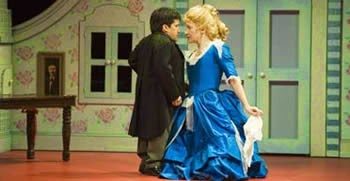
Photo: Richard Termine
In his director's note to the Mabou Mines's product, Lee Breuer writes that in his version of the famous story "Ibsen'due south feminism is metaphorically rendered every bit a parable of scale. The 'dollhouse' is a man'due south world and but doll-like women who let their men to feel grand tin promise to alive in it. 'It'due south a small world.' Goose egg here is real except the pain. Both Torval and Nora are trapped in a meta-narrative playing out an illusion of male power. Both pay the price: the expiry of love." As we all know by at present, in Breuer's vision, all women are vi anxiety tall and all men are midgets.
Simply is Mabou Mines'southward product really near gender, or is it virtually something else? What is its true meta-narrative? In Breuer's take, power is delusory because information technology is based on diff concrete attributes. Thus, conversely, the "real" power, co-ordinate to Breuer, is tied to height and physical strength, merely nearly chiefly, "real" power, in the Mabou Mines'south production, is tied to wellness and disability. Men are powerless considering they're curt and disabled, not considering they're morally or psychologically weak. Women are the ones who are "truly" powerful because they're tall, physically stronger and healthy. Thus, height is connected to power, simply what's more than, disability is connected to power, or rather to the lack of it. In that arrangement, the men play nothing but their "smallness" in very much the same way that for most of the last century, blacks played their "blackness" – as maids, servants, prostitutes, serial rapists, and occasionally Othello.
Would the production be equally acclaimed if men were to wear dresses or act overly feminine, while women were to wear suits and act overly masculine? Would it be equally hailed as "stunning" and "lovingly re-examined" if the ability lines were drawn along racial lines? By now, we are used to thinking of race and gender as social constructs, so such adaptations would on some level offend the states. We are not yet used to thinking of disability as a social construct, and most likely we never will be. Disability, dissimilar gender or race, is rooted too much in our cultural framework; information technology is as well much jump to its essential, biological characteristics. So, nosotros don't even blink or discover when, on stage, it plays itself and its own tragic history.
Historically, the disabled, midgets, dwarfs, giants and other man oddities performed equally various novelty acts in circus freak shows, often making small fortunes with their acts. In the U.S., the most famous example is P.T. Barnum'south Charles Stratton, a two-foot-alpine midget, whose proper noun was changed to General Tom Thumb to attract audiences. After Stratton's wedlock to another midget, Barnum went so far as to denote the birth of their false infant as a publicity stunt. Stratton and his family would somewhen go one of Barnum'due south biggest coin-makers, prompting him to declare (allegedly) that "In that location's a sucker born every minute." The job of a circus freak who was disabled meant playing nothing else but ane's own freak-show body, but information technology sure beat begging or dying on the streets, which nigh of them did, and many still do all effectually the world.
Today in American culture, every historically marginalized group has its ain theoretical and colloquial language of social and political struggle, the vocabulary of "usa" versus "them," the war machine language of loyalty, treason, and expose. African-Americans take their "uncle Toms" and their "oreos." Gays accept their Roy Cohns and Ted Haggards, the two extreme closeted icons of tragic cocky-loathing. Feminists take their Playboy bunnies, their Palinistas, and other nemeses. These vocabularies, terminologies, and identities reverberate the many tensions in the contemporary minefield of identity politics, but nearly of all they reflect a existent tension between "nosotros" – the recognition of mutual history and struggle – and "I" — the human need to assert 1's existential and ethical singularity. The disability community is no different from all other minority groups. It has its own complex and subtle vocabulary of loyalties and belonging.
I have always tried to straddle the sparse silver line betwixt "we" and "I," often playing and arguing both sides of the argue. Equally Milan Kundera tells us, life on the border tin can be a lonely journey, only this is the path I've consciously – if somewhat romantically and cocky-righteously – called. But, to borrow from Condoleezza Rice, I've been disabled my entire life, and no one can teach me or tell me what it means to be properly disabled. Perversely, I have always felt stronger as "I" than equally "we" – perhaps for no reason simply my own puerile belief in the force of my willpower and an equally puerile suspicion of all collective endeavors. But I accept never resented the many disabled who chose to perpetuate the freak-testify tradition – whether in theater or on reality television receiver – simply considering for many of them information technology is the only stable and viable source of income. Information technology is extremely difficult – often impossible – to become a respected three-foot-tall gauge, or doctor, or anything else for that matter. I've never resented the mini Lady Gagas or Saint Patty'southward leprechauns, though I did pity them, while also fully aware of how extremely difficult they make it for the balance of usa, those who are trying, via some kind of dignified back door, to run away from the circus.
Where in all this does Mabou Mines fit? While trying to make a argument on gender relations, "playing out an illusion of male ability," the production takes from disability what it gives to gender. Was the trade-off necessary? In many ways, Mabou Mines's Dollhouse is nothing just a midget novelty human activity, an extension of the circus freak evidence, a reality-goggle box, Ivy-League version of the Howard Stern show, wooing its audiences with the hope of a titillating, if slightly more than sophisticated, kinky midget-sex tension.
A few years ago at the opening reception of a theater production, a fairly well-known international actor asked me bluntly in the middle of casual chitchat how I accept a shower. Pretending to misunderstand his question, I answered with an innocently perverted blend of Shirley Temple and Dita Von Tesse: "Naked, of course – why? Do y'all want to watch?" The multilayered mockery in my phonation was lost on him, as was the brazen buffoonery of his voyeuristic impulse.
For someone who has tried her entire life to escape the circus, watching Dollhouse felt similar existence trapped in a nightmare, the kind I lived in the backward Shine countryside more than thirty years agone. It fabricated me simultaneously nauseous, aroused and defeated, pushed onto the margins outside of the human race. This is how W.Due east.B. du Bois would have felt watching a southern Minstrel show. Indeed, I couldn't help but exist reminded of Spike Lee's famous, heartbreaking montage of racist cartoons in his iconic-by-now movieBamboozled. This is how Walter Benjamin must have felt watching whatsoever production of Shakespeare'due southMerchant of Venice in Nazi Germany…
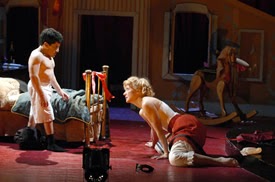
Photo: Richard Termine
The longer I watched the Mabou Mines's production ofDollhouse, the more I couldn't stand it. There it was: my own nightmare montage complete with oversexed dwarf with Satyr-similar horns and whimsically crooked dildo – an prototype familiar from aboriginal art and medieval woodcuts: the tall human being's fearful fantasy of the dwarfish man'due south mythically large penis (parallel to the all-likewise-familiar white human's fright of the blackness human's sexuality). Playing on the medieval iconography – without the to the lowest degree bit of ironic self-awareness – Mabou Mines's discourse on power, sex, and the body is as reductive and unsophisticated every bit the medieval iconography it so freely employs and exploits for easy laughs.
I had thought that in terms of theater and film representations of the disabled, we were at the same point of progress that African-Americans and gays were during the 1960 and 1970s. That is, the electric current iconography operates mostly via stereotypes, with an occasional pleading tear-jerker, topped with the redemptive death of the freak at the finish of the story: eastward.thousand.Water for Elephants (2011),Simon Birch(1998), andThe Year of Living Dangerously (1982). The disabled midget characters in these stories are sacrificed so that the main hero tin attain his goal (usually through gaining the inner strength to do what'due south right); they are viewed equally narrative stepping stones, and never as partners, people in their ain right, with their ain drives and ambitions. But watching Mabou Mines'sDollhouse, I have realized that we're non even in the twentieth century yet. Coco Fusco, withCouple in the Cage, and Susan Lori Parks, withVenus, made us enlightened of the complex and painful relationship between voyeurism and exploitation of the ethnic body. But, then it seems, nosotros're withal a very long way from condign aware of the voyeurism and exploitation of the disabled body. To quote my friend, Dollhouse "isn't some mail-modern quotation of offensive traditions; it's an human activity of injury in its ain correct."
When Martha Nussbaum was writing her volumeFrontiers Of Justice: Inability, Nationality, Species Membership, I had a conversation with her about its main ethical premise: the notion that the disabled had a philosophical responsibility to justify their biologically flawed beingness by freely dispensing heaps of inspiration, awareness, and wisdom unto the good for you, and thus gleefully unaware, crowds. The disabled are obliged to perform this social service with sincere generosity and heartfelt conviction while maintaining the illusion that information technology is their desire to be understood that propels their generosity in order to allow the normal others their cathartic moments of false dignity and cocky-awareness. "Why exercise you," I asked Martha, "assume that I take a burning desire to be understood by you? What makes your understanding so special, so superior that I must seek it?" The fact is, many disabled don't have a called-for desire to be understood by the majority of people simply because the kind of agreement they seek is beyond the limits of most of those people's actual imaginations. Our contemporary theater is the all-time proof of that (and the fact that Hollywood's surest road to the Oscar is a moving portrayal of the cripple–such portrayals are simply beyond the acting abilities of most actors).
Peter Weiss's metatheatrical Marat/Sade comments on the tradition of exhibiting the mentally ill and their antics for the viewing pleasance of French audiences, but the shows at Charenton mental hospital depicted in Weiss's play are merely i more anachronistic reflection of our ain contemporary sensibilities, from Robert Wilson'due southDeafman Glance, through Mabou Mines'southwardDollhouse, to the well-nigh recentNot Past Bread Alone— a performance by Nalagaat, an Israeli theater ensemble of deaf and bullheaded actors — or Ganesh Versus the Tertiary Reich by the Back to Back Theatre of Geelong, a grouping of mentally challenged actors from Australia, performing under the watchful eyes of Bruce Gladwin. Every bit the New York Times recently noted: "These younger companies embrace awkwardness and even amateurishness to emphasize the separation between performers and functioning." [3] In this context, disability functions as a formal quality of an avant-garde theater in the same style that "blackness" functioned as a formal quality in 19th-century fine art: to emphasize the artful (and other) difference between the viewer and the object looked at. Disability is not incidental; it is the essential and the just quality of an object.
All of these shows are directed past "normal" directors, and their main entreatment is the promise of voyeuristic access to the intimate world of the freakish other, on safe, controlled and anticipated terms. The official politics of this freak-show spectatorship revolves around the clichéd notion of "spreading sensation." Awareness of what? If you desire to be aware of what information technology means to be blind, deaf, or in a wheelchair, spend a week being blind, deaf, or in a wheelchair. Don't turn me into your "magic cripple" (to borrow Spike Lee'south concept of the "magic negro"), whose soleraison d'être is to guide you toward greater moral self-awareness and enlightenment.
Originally posted atHotReview(ten/11/12). Reposted with permission.
NOTES
- Joan Templeton, I bsen's Women(Cambridge Upwardly, 2001), 136.
- Lyn Gardner, "Ibsen's classic gets shrunk in the launder: Mabou MinesDollHouse,"The Guardian, Aug. 27, 2007, 32; Robert Dawson Scott, "Absurd in its Perfection,"London Times, Aug. 28, 2007, 14.
- Ben Brantley, "Theater Talkback: Defying Expectations Off Broadway,"The New York Times, Jan. 27, 2013, AR6.
This postal service was written past the writer in their personal capacity.The opinions expressed in this article are the writer's ain and do not reflect the view of The Theatre Times, their staff or collaborators.
This mail was written by Magda Romanska.
The views expressed hither belong to the author and do not necessarily reflect our views and opinions.
Source: https://thetheatretimes.com/escape-circus-review-mabou-mines-dollhouse/
0 Response to "Reviews for This Was the End Mabou Mines"
Postar um comentário