Art Pictures With Sun in Upper Right Corner of Page
Values are the different shades of grayness betwixt white and black. Artists use values to translate the calorie-free and shadows they see into shading, thus creating the illusion of a third dimension.
Hatching and crosshatching are simple and fun techniques for drawing shading.
A full range of values is the basic ingredient for shading. When you can draw lots of dissimilar values, y'all can begin to add shading, and therefore depth, to your drawings.
With shading, the magical illusion of three-dimensional reality appears on your cartoon paper. Figure ane demonstrates hot to take a unproblematic line drawing of a circumvolve and add shading to transform it into the planet Earth.
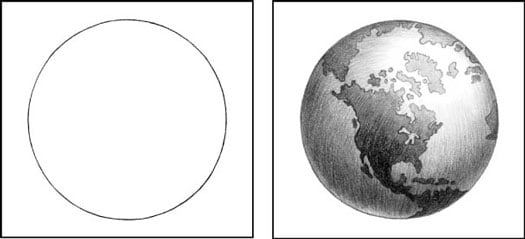
You know the objects effectually you are three-dimensional considering you can walk up to them, see them from all sides, and touch them. Accept a moment to look around yous at familiar objects. Attempt to detect why you lot see their actual three-dimensional forms. Look for the different values created by the calorie-free and shadows.
Taking a closer look at light and shadow
Before yous can draw the appropriate values that illustrate light and shadows correctly, yous need to be able to visually identify the following:- Light source: The management from which a ascendant light originates. The placement of this low-cal source affects every aspect of a drawing.
- Shadows: The areas on an object that receive little or no lite.
- Cast shadow: The dark area on an adjacent surface where the light is blocked by the solid object.
The light source tells you where to draw all the light values and shadows.
Effigy two gives yous some do in locating the light source, shadows, and cast shadows around an object, which in this instance is a sculpture. As you look at two drawings of the sculpture, inquire yourself the following questions:
- Where are the light values? Look for the lightest areas on the object. The very brightest of the lightest values are called highlights.
- Where are the dark values? Nighttime values often reveal the sections of the object that are in shadow. Past locating shadows, you can usually identify the light source.
- Where is the cast shadow? The section of the cast shadow closest to the object is usually the darkest value in a drawing. Past locating an object's cast shadow, y'all can easily notice the direction from which the calorie-free source originates.
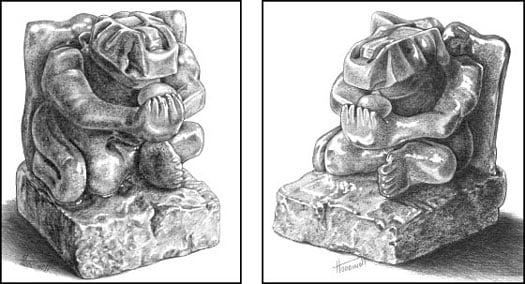
The two drawings in Figure ii have different low-cal sources. Compare them and discover the dominant light source in each.
If you guessed that the light is coming from the right in the kickoff cartoon, you would be correct. In the 2d drawing, the light originates from the left.
Seeing how a lite source affects an actual object is more challenging than examining a drawing. Place an object on a table in a dimly lit room. Polish a powerful flashlight or a lamp (a light source) on the object. Discover it from different perspectives.
Each time you reposition the light source, identify the following:- The shadows on the object (dark values)
- The brightest areas (the highlights)
- The light values (areas closer to the calorie-free source or not in shadow)
- The cast shadow (the darkest values)
Exploring contrast in a drawing
Contrast tin exist used to make your drawings more three-dimensional past accentuating the light and shadows. By using extremes in values (more light and dark values than middle values) y'all create a loftier-dissimilarity drawing. For a really powerful, stiff, and dynamic drawing, y'all can describe very dark shading right adjacent to the lite areas.When a drawing has more often than not light and middle values, it is chosen low contrast. Some cartoon subjects need to be soft and gentle. You lot can create a very soft drawing and nevertheless use a total range of values. Remember almost a white kitten, for instance. Nigh of the shading is very light, merely the cartoon becomes more powerful if yous use a little dark shading in a few selective areas, such as the pupils of the eyes and the shadows.
Your drawings can announced flat rather than 3-dimensional when you employ also little contrast in values. Unless you are trying to accomplish a specific mood or want the bailiwick to look apartment, e'er use a full range of values.
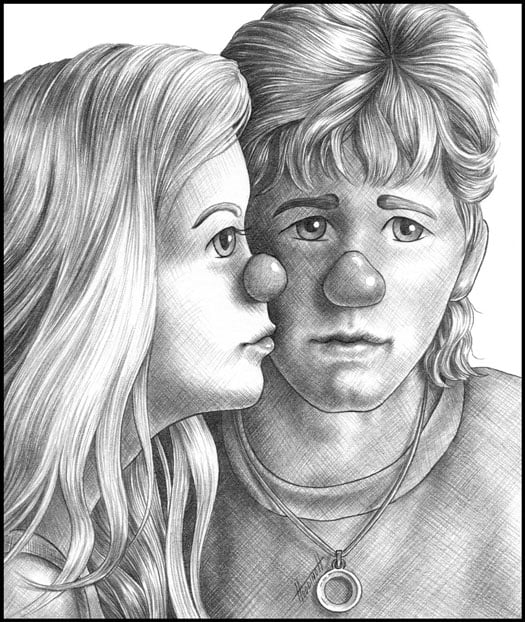
Figure 3 helps you see contrast while exercising your vision. Take a few moments to explore the calorie-free and shadows in this drawing more than closely. The face of the daughter is drawn in profile. The boy's face is a frontal view. Detect how the girl's profile is in the shadow of the male child's confront.The bright lite on the front of her face presents a strong dissimilarity to the dark shadow on the side of his face. This makes for a powerful visual separation fifty-fifty though the two faces seem shut together.
Translating values y'all see into values you draw
Almost everything has more than than ane value. Depending on the light source, most things have some areas that are very light and others that are quite dark.If y'all look closely at a mound of dark world, yous notice that it has several dissimilar values. If a fresh layer of snow covered this mound of earth, there would still be lots of values. When you can see a range of different values you can draw your subject field in the third dimension.
Squinting to see values and uncomplicated shapes
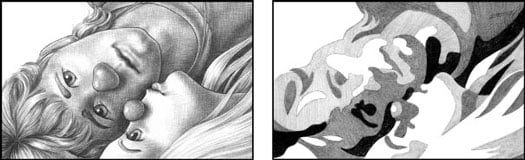
Seeing values is key to drawing in the third dimension. Many artists can visually simplify complex cartoon subjects by merely squinting their eyes. Squinting helps you screen out details and meet simple values and shapes. When you can come across the shapes created past different values, you can describe your field of study more accurately.Look at Effigy 4 and squint your eyes until the paradigm seems to exit of focus. Compare the darkest values to the lightest, and try to run into the abstract shapes created by the different values.
The second cartoon shows what you may see when you squint. Take note of the shapes created past the values.
Turning colors into values with squinting
Many drawing media, such as graphite, are designed for black and white drawings. Yet, most everything in the world is in colour. You need to adjust your visual perceptions to see these colors equally shades of grey when cartoon.Wouldn't information technology be nice if you could simply printing a button in the middle of your forehead and magically transform the earth from full color to grey values? This power would certainly brand drawing a lot easier. Thankfully, only squinting your optics can help yous develop this skill.
Try these suggestions to help you train your mind to translate colors into values:
- Look around y'all at different objects. Focus on only the light and nighttime areas and not the actual colors. Concentrate on the low-cal and shadows. Then squint your optics until yous see the values of that object. Take a mental note of where the lights and darks are. Retrieve about how you could draw these darks and lights. Don't become discouraged if yous can't do it right away. With exercise, you get better.
- Observe a colored photo with lots of contrast. Squint your eyes to block out the colors and details. In your sketchbook, describe only the uncomplicated shapes and values you meet. Add together shading with merely black, white, a lite value, and a heart value.
Source: https://www.dummies.com/article/academics-the-arts/art-architecture/drawing/general-drawing/drawing-light-and-shadows-200446/
0 Response to "Art Pictures With Sun in Upper Right Corner of Page"
Postar um comentário